Pickens County Cattlemen’s Association
EDUCATE - CONNECT - ADVOCATE

Coming in November
-
BIDS & BBQ
-
Coming in November - BIDS & BBQ -
Welcome to the PCCA!
We are a community of cattle producers focused on Education, Community, and Advocation.
Welcome to our corner of the farming world, where passion meets purpose in caring for livestock. We’re building a community rooted in trust, practical knowledge, and sustainable practices—working alongside you to raise healthy, thriving animals.
The Pickens County Cattlemen’s Association hosts informative meetings covering a wide range of topics, including pasture management, calving challenges, herd health, and selecting the right bull—just to name a few. We are dedicated to supporting the cattle industry and promoting beef production. As stewards of both the land and our livestock, we are committed to responsible and sustainable practices.
Upcoming Events
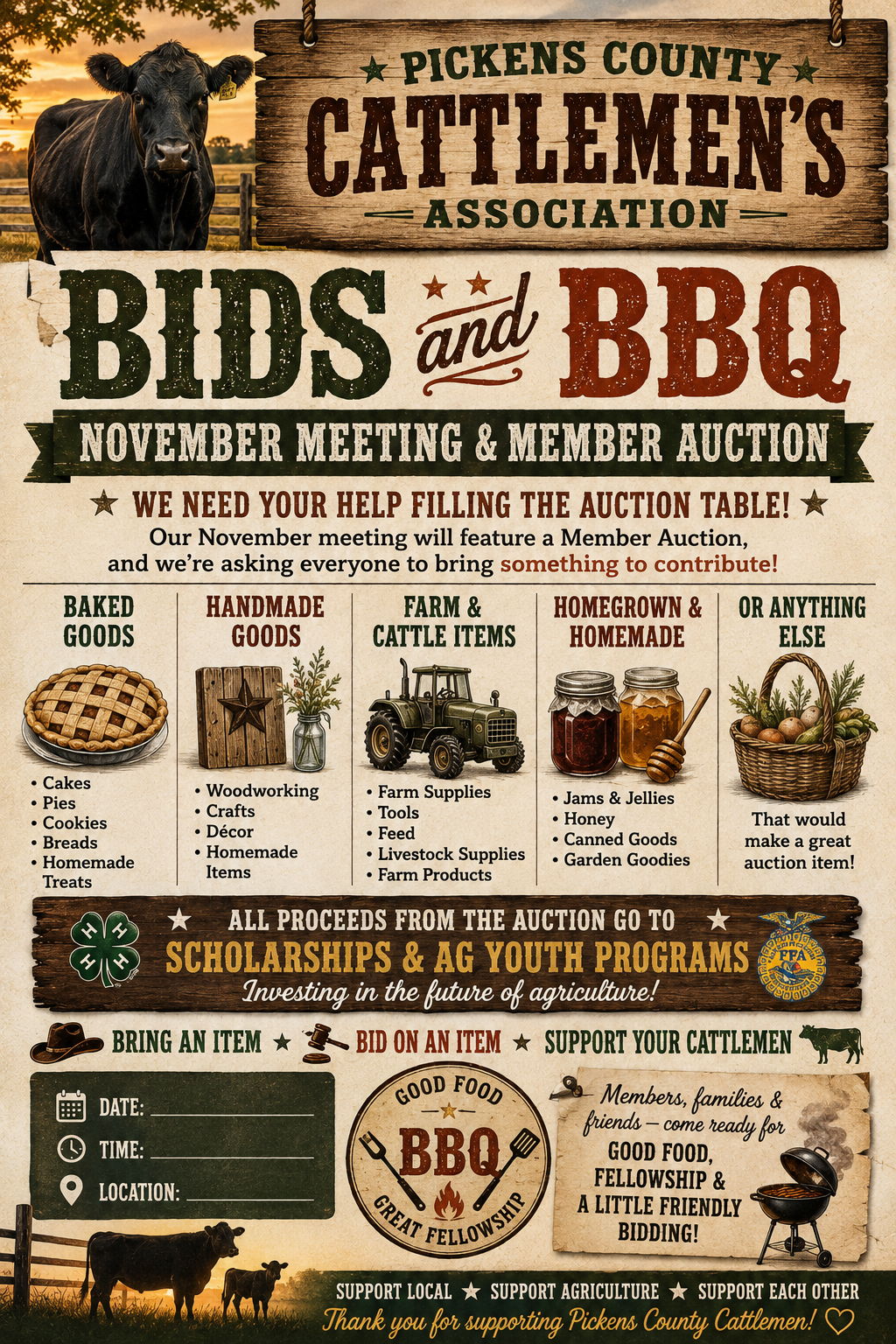
BIDS & BBQ
Where Good Food Meets a Great Cause! 🐂🔨
Join the Pickens County Cattlemen’s Association for an evening of BBQ, fellowship, and a little friendly bidding at our Bids & BBQ Member Auction!
Come hungry, bring something fun for the auction table, and get ready to bid on everything from homemade treats and handcrafted goods to farm finds, local products, and one-of-a-kind surprises.
Best of all, auction proceeds support scholarships and agricultural youth programs, helping invest in the next generation of agriculture.
🌟 Bring an item. Bid on an item. Eat some BBQ. Support local agriculture.
Bring your family and friends and make a night of it — you never know what treasure might hit the auction block!
Tri-State Expo
Finley Farms
Triple Lake Farms
Chapel Stone Custom Leather
Finley Farms Triple Lake Farms Chapel Stone Custom Leather
PCCA Member George Hood’s family cattle farm
PCCA Member Spotlight
George Hood - Hood Family Farm
The Hood family farm in Easley is a 5th generation commercial cow/calf operation, currently sired by Angus or Balancer bulls. It began in the 1920’s with cotton, corn, and a small dairy. In the 1950’s, fescue was sown on all land, and the current beef cattle operation began with 2 pastures totaling 60 acres.
Beginning in 2011, with assistance and guidance from USDA/NRCS, the pastures were cross-fenced with permanent fencing into 6 smaller paddocks. Those 6 paddocks are further divided into smaller, temporary paddocks, with access to shade, using 1 strand, polywire electric fencing. This provides the ability to utilize rotational grazing, which allows the forage to rest, recover, and regenerate for substantial periods of time.
A well was also drilled at that time, and 3 Murafont watering tanks were installed strategically across the farm, into fence lines, to provide water in each paddock. Cattle were then permanently fenced out of the on-site pond and stream, improving water quality downstream.
Soil tests are collected in the fall, and fertilizer is applied based on needs. This allows forage to be stockpiled for late fall/early winter grazing. Ideally, hay is fed for 30-45 days, from late January until early March. A light application of nitrogen is often applied in early spring.
The family’s goal, for generations, has always been to improve soil, forage, and bloodlines, year to year, on the land entrusted to them.
Your Questions, Answered
-
The Pickens County Cattlemen’s Association offers valuable resources and supportive guidance for producers at every stage—from those just getting started to seasoned cattlemen looking to expand and improve their operations. Through practical educational meetings, strong local connections, and the sharing of firsthand knowledge and best practices, we help you make informed decisions and move forward with confidence and purpose.
-
Getting started is simple. Reach out through our contact information and we’ll walk you through the next steps and answer any questions along the way.
-
You can reach us anytime via our phone number, monthly meetings or email. We want to talk to you!
-
We have several membership levels. Check out our membership page!